
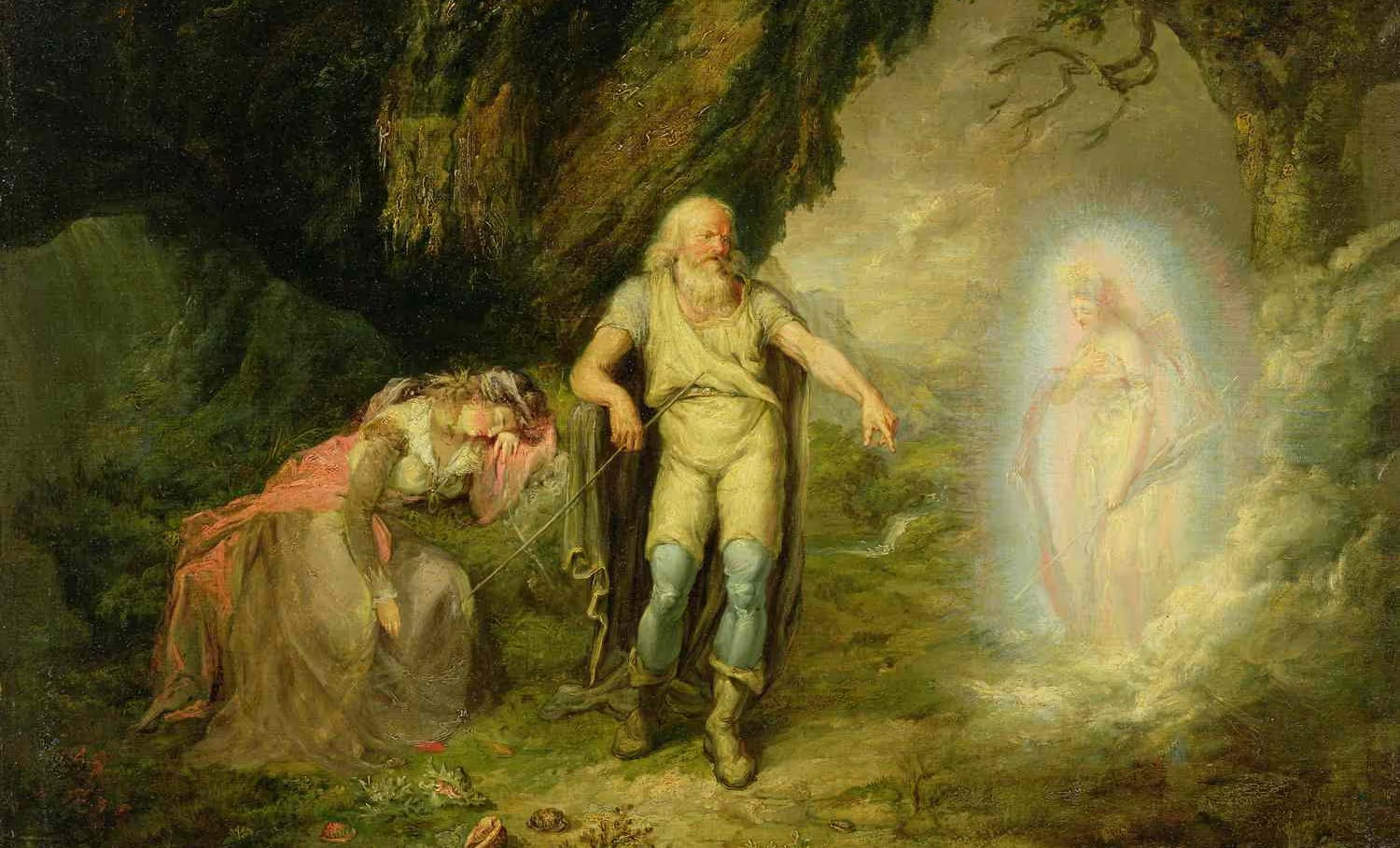
Why does The Tempest still matter?
Shakespeare wrote The Tempest over 400 years ago, at the twilight of his career. It is filled with magic, shipwrecks, spirits and reconciliation, so why does a 21st-century novelist like Margaret Atwood revisit it in Hag-Seed?
The answer lies at the heart of Module A: Textual Conversations.
The textual conversation between The Tempest (1611) and Hag-Seed (2016) endures because it allows us to trace how universal human experiences such as power, betrayal, forgiveness, control and freedom are reimagined across radically different contexts. Studying these texts together reveals not only what changes over time, but what endures.
Shakespeare’s The Tempest is a Jacobean romance that explores authority, colonialism, magic and reconciliation. It is often read as Shakespeare’s meditation on art, authorship and the act of letting go. Atwood’s Hag-Seed is a contemporary novel that reimagines The Tempest through a postmodern lens, relocating the story to a Canadian prison education programme.
Despite the 400 year gap, the same core concerns persist, but they are reframed. To succeed in Module A, students must treat Hag-Seed not as a retelling, but as a critical reimagining that speaks back to Shakespeare’s original.
The textual conversation emerges through comparison of form, characterisation, themes and contextual values. Your role is to explain how these texts resonate and diverge, and what this reveals about enduring human concerns.
In Module A, a textual conversation refers to the deliberate relationship between an earlier canonical text and a later reimagining.
The later composer:
A key idea to remember:
While the mechanisms of power shift — from magic and divine authority in Shakespeare to psychology, education and institutions in Atwood — the human desire for control and recognition remains constant.
Your goal in Module A is to show that reading these texts together deepens our understanding of how meaning is shaped by context, form and values.
Prospero is the architect of The Tempest. Through magic, books and language, he controls the island, its inhabitants and the narrative itself. He orchestrates the storm, manipulates characters through illusion and stages events to engineer repentance. His authority reflects Jacobean beliefs in hierarchy, divine right and mastery over nature. In the epilogue, where he renounces magic, he appears both ruler and playwright, inviting the audience to reflect on power, art and mercy.
In Hag-Seed, Atwood reimagines Prospero as Felix Phillips, a disgraced theatre director. Felix’s “magic” is theatre. Instead of spirits, he uses prisoners as actors. Instead of an enchanted island, he controls a correctional facility. Atwood reframes control as institutional and psychological rather than supernatural. Felix’s obsession with revenge mirrors Prospero’s, but his authority is fragile and deeply shaped by grief.
Both texts explore the tension between control and release. Prospero must relinquish magic to achieve reconciliation. Felix must relinquish vengeance and grief to reconnect with society. Atwood’s reimagining questions whether Prospero’s forgiveness is purely noble, reframing it instead as a necessary act of self-liberation.
Shakespeare wrote The Tempest during the reign of King James I. This was a period shaped by:
Society was structured hierarchically. Kings ruled by divine authority. Social order reflected God’s will.
Prospero’s control over the island mirrors this worldview — he believes his authority is justified, natural and morally superior.
When Prospero restores order and forgives his enemies, the play reinforces the Jacobean belief that:
England was beginning to establish colonies in the “New World.” Travel narratives described unfamiliar lands and peoples as exotic, dangerous or uncivilised.
Caliban reflects early colonial attitudes:
Yet Shakespeare complicates this portrayal. Caliban’s lyrical description of the island’s “sounds and sweet airs” reveals sensitivity and humanity. The play subtly questions whether colonisation is truly justified.
The Renaissance celebrated knowledge, art and intellectual mastery. Prospero’s books symbolise learning and power. However, his eventual renunciation of magic suggests that excessive control must be relinquished.
The play can be read as Shakespeare’s farewell to theatre; Prospero resembles a playwright orchestrating illusion before “drowning his book.”
Margaret Atwood writes in a vastly different world:
Authority is no longer divinely ordained. Power operates through:
Felix is not a duke, he is a theatre director dismissed by corporate politics. His authority is fragile and institutional.
Modern readers are more sensitive to colonial injustice. Atwood amplifies Caliban’s perspective by allowing prisoners (society’s marginalised) to reclaim his voice.
Colonial domination becomes:
Unlike Jacobean punishment, modern correctional systems aim (at least theoretically) to rehabilitate. Theatre becomes a transformative tool. Art empowers rather than dominates.
Atwood writes in a society shaped by feminist movements. She expands female agency through Anne-Marie and reframes Miranda as more than a passive daughter.
Through context, we see the shift:
Form determines meaning.
The Tempest was written for live performance. It relies on spectacle, illusion and music. The audience witnesses reconciliation unfold before them, reinforcing the sense of theatrical authority. Metatheatre appears through Prospero, who resembles a playwright controlling events and characters.
Hag-Seed, however, is a postmodern novel. It incorporates flashbacks and internal monologue. Felix consciously stages The Tempest, analysing and rewriting it within the narrative. Atwood transforms Shakespeare’s subtle metatheatricality into explicit metafiction, foregrounding the process of adaptation itself.
The difference in form shapes how we interpret power, imprisonment and forgiveness.
Imprisonment operates both literally and symbolically in both texts.
In The Tempest, the island becomes a site of control and colonisation. Prospero enslaves Caliban and binds Ariel to service. Caliban is repeatedly described in dehumanising terms, reflecting early colonial attitudes that justified domination through racial and cultural superiority. The island functions as a microcosm of European expansion, where power is asserted through ownership and subjugation.
Yet Shakespeare complicates this portrayal. Caliban’s poetic speech about the island’s “sounds and sweet airs” reveals depth and sensitivity, unsettling simplistic assumptions of savagery. The play thus exposes the moral ambiguity of colonial authority.
Atwood reimagines this dynamic through the prison setting. In Hag-Seed, incarceration is literal. The marginalised are not colonised islanders but inmates excluded from society. By having prisoners perform The Tempest, Atwood allows them to reclaim Caliban’s voice. Colonial domination becomes institutional marginalisation, and performance becomes a tool for reclaiming identity. The theme of imprisonment shifts from territorial conquest to social exclusion and rehabilitation.
Betrayal initiates both narratives. In Shakespeare’s play, Antonio’s usurpation of Prospero’s dukedom sets revenge in motion. Prospero’s manipulation of events demonstrates his desire for retribution. However, revenge threatens to consume him, isolating him morally.
Shakespeare ultimately privileges forgiveness. When Prospero recognises that “the rarer action is in virtue than in vengeance,” he chooses mercy over retaliation. Forgiveness restores political stability and reinforces a moral order grounded in reconciliation.
Atwood aligns with this critique of revenge but reframes its meaning. Felix’s betrayal by Tony is professional rather than political, yet it becomes emotionally destructive because it is intertwined with grief for his daughter. His revenge feels hollow when achieved. Unlike Prospero’s restoration of hierarchy, Felix’s release comes through letting go of Miranda and relinquishing resentment. Forgiveness becomes psychological rather than divine.
Through this shift, Atwood transforms forgiveness from a public restoration of order into a private act of healing.
Gender reveals another significant divergence between the texts.
In The Tempest, Miranda’s identity is largely shaped by her relationship to Prospero and Ferdinand. She is protected, directed and ultimately offered in marriage as part of political reconciliation. Her role reflects the patriarchal assumptions of Jacobean society, where women were positioned within male authority.
Atwood responds by expanding female agency. In Hag-Seed, Miranda exists as both memory and influence, shaping Felix’s moral decisions. More significantly, Anne-Marie, who plays Miranda in the prison production, embodies independence and assertiveness. She challenges paternal control and asserts her professional authority within the theatre programme.
By amplifying female voice and autonomy, Atwood reframes Shakespeare’s gender dynamics for a contemporary audience shaped by feminist awareness.
Hag-Seed is not simply The Tempest in modern clothing. It is a critical reimagining that preserves Shakespeare’s exploration of power and forgiveness while challenging colonial hierarchies, reconfiguring imprisonment and amplifying female agency.
By showing how Atwood talks back to Shakespeare and why that matters, students demonstrate exactly what Module A assesses: insight into enduring values shaped and reshaped by context.

We provide specialised English tutoring for students in Years 7 to 12, helping them build strong foundational skills, master the NSW English syllabus, and excel in HSC English.
Yes, all our lessons are carefully aligned with the NSW English syllabus. ensuring students are fully prepared for school assessments, exams, and HSC English requirements.
We start with an Introductory Lesson to assess each student’s strengths, weaknesses, and learning style. Our English tutors then design personalised lesson plans aligned with the NSW English syllabus to ensure targeted learning.
All our classes are one-on-one. This allows us to accommodate different learning preferences, ensuring each student receives the attention and support they need.
Absolutely. Our tutors are experienced in guiding students through preparing for specific assessments, exams and assignments, providing targeted feedback and strategies to help them succeed.
Yes, we provide weekly content, comprehensive resources, including practice materials, worksheets, and model responses, to help students consolidate their learning and practice independently.
Typically, each session is 90 minutes. Our termly courses are at least once a week, but the frequency can be tailored based on their needs and academic goals.
Yes, we offer both in-person and online tutoring to accommodate different preferences and ensure flexibility in learning.
Yes, we offer new students an Introductory Lesson with no obligation to continue. This allows new students to experience our teaching approach, meet their tutor, and decide if our personalised English tutoring is the right fit for their learning needs.
You can contact us either through our email at tutor@goldstandardacademy.com or call us at 0481 336 988


