
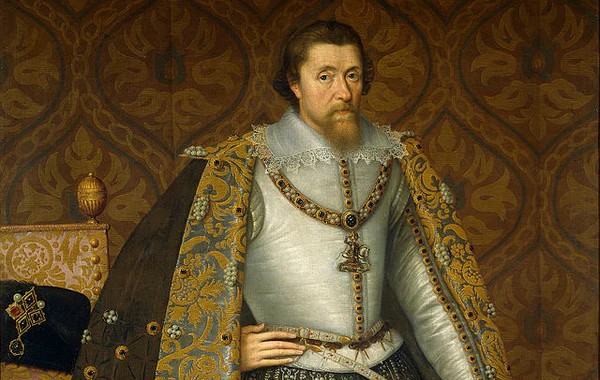
To engage meaningfully with Shakespeare’s later plays, one must look beyond their dramatic brilliance to the shifting historical and cultural forces that reshaped his world. When James I ascended the English throne in 1603, the Elizabethan age gave way to the Jacobean Era — a period that inherited much of its predecessor’s energy but redirected it in darker, more complex directions. Political tensions deepened, religious uncertainty intensified, and the theatre became an even more pointed arena for exploring power, corruption, and mortality. Understanding the Jacobean world is essential to reading Shakespeare’s later works not merely as drama, but as reflections of a society undergoing profound transformation.
The Jacobean Era (1603–1625) began when James VI of Scotland inherited the English crown following the death of Elizabeth I, bringing England and Scotland under the rule of a single monarch for the first time through the Union of the Crowns. Although the two kingdoms remained politically separate until the Acts of Union in 1707, James’s accession marked a major shift in British politics and culture.
Unlike Elizabeth, who ruled with calculated charisma and political flexibility, James was a scholarly king with firm beliefs in the divine right of kings — the idea that monarchs derived their authority directly from God and were therefore owed obedience by their subjects. He articulated these ideas in The True Law of Free Monarchies (1598), a political treatise defending royal authority.
This shift from Elizabeth’s more pragmatic leadership to James’s stronger emphasis on royal absolutism created new cultural tensions. While Elizabethan drama often explored succession and legitimacy with a sense of optimism, Jacobean drama more frequently examined tyranny, corruption, instability, and moral ambiguity. Shakespeare’s later plays — Macbeth, King Lear, The Tempest, and Othello — emerged within this changing political climate, and their themes cannot be fully understood without it.
Despite its tensions, the Elizabethan era was often characterised by a spirit of national confidence. England had defeated the Spanish Armada in 1588, expanded its global influence through exploration, and flourished culturally under a monarch who projected strength and stability.
The Jacobean period inherited a more uncertain world. James’s accession was quickly followed by the Gunpowder Plot of 1605, a failed Catholic conspiracy to blow up Parliament and assassinate the king. The event intensified fears surrounding religious conflict, political dissent, and conspiracy — anxieties that are clearly reflected in Macbeth, likely written shortly after the plot, with its themes of treachery, regicide, and the collapse of social order.
Where Elizabethan court culture often celebrated the monarch through pageantry and symbolism, Jacobean court culture became increasingly associated with political favouritism and corruption. James’s reliance on powerful favourites such as Robert Carr and George Villiers fuelled resentment among sections of the nobility and contributed to growing criticism of the royal court.
Religion remained a dominant force in Jacobean England, but the religious landscape had become increasingly fractured. Elizabeth’s Anglican settlement aimed to establish a broad Protestant identity capable of accommodating different groups. James, however, faced competing pressures from Puritans seeking further reform, Catholics hoping for greater tolerance, and Anglican authorities resistant to change.
The Hampton Court Conference of 1604 led to the commissioning of the King James Bible (1611), one of the most influential texts in the English language. Although the conference failed to satisfy many Puritan demands, the new translation reinforced both religious uniformity and royal authority over the Church.
This climate of spiritual uncertainty is deeply embedded within Shakespeare’s Jacobean plays. Questions surrounding divine justice, providence, suffering, and evil permeate works such as King Lear, Macbeth, and The Winter’s Tale. The supernatural elements in these plays were not merely theatrical spectacle; they reflected genuine cultural concerns about God’s presence, morality, and the limits of human understanding.
One of the most significant developments of the Jacobean period was the changing nature of theatrical performance. During Elizabeth’s reign, public theatres such as the Globe attracted audiences from across the social spectrum. Shakespeare’s company, the Lord Chamberlain’s Men, performed for both ordinary citizens and aristocratic patrons.
After James’s accession, the company received royal patronage and became known as the King’s Men. This royal association elevated the company’s prestige while also increasing political sensitivity surrounding theatrical content.
At the same time, indoor theatres such as Blackfriars became increasingly popular. These venues catered to wealthier audiences, charged higher admission prices, and allowed for more sophisticated lighting, music, and stage effects. Shakespeare’s later romances — The Tempest, Cymbeline, and The Winter’s Tale — show evidence of being shaped for these more intimate theatrical spaces.
The theatrical world itself was becoming more socially stratified, reflecting wider changes within Jacobean society.
Elizabethan England had embodied a striking contradiction: a patriarchal society governed by a powerful unmarried queen. Elizabeth’s authority both challenged and reinforced traditional gender expectations.
Following her death, these tensions did not disappear. James’s court was more overtly masculine in its political culture, and his close relationships with male favourites became subjects of public discussion and controversy.
At the same time, James’s interest in witchcraft heightened elite anxieties surrounding female power and social transgression. In Daemonologie (1597), James explored the dangers of witchcraft and the supernatural. This cultural climate strongly influenced Macbeth, whose witches embody fears surrounding disorder, temptation, and destabilising forms of female authority.
Yet Jacobean drama also produced some of Shakespeare’s most sophisticated female characters. Figures such as Hermione in The Winter’s Tale, Imogen in Cymbeline, and Miranda in The Tempest reveal a nuanced exploration of women’s intelligence, morality, and resilience within restrictive social structures.
While Elizabethan literature often projects confidence, vitality, and human ambition, Jacobean literature more frequently explores corruption, instability, mortality, and psychological conflict.
The revenge tragedy flourished during James’s reign through playwrights such as John Webster, Thomas Middleton, and Cyril Tourneur. Shakespeare himself increasingly gravitated toward darker material: Macbeth’s destructive ambition, Lear’s despair, and Prospero’s disillusionment.
Even the romances and comedies of the Jacobean period are shadowed by betrayal, suffering, and loss. Restoration and reconciliation remain possible, but they are achieved only after profound hardship and self-reflection.
This tonal shift reflects broader historical realities. Political uncertainty, recurring plague outbreaks, religious tensions, and growing conflict between Parliament and the monarchy contributed to a cultural mood more alert to the fragility of order and authority.
If Elizabethan drama frequently examined legitimacy and succession, Jacobean drama pushed further into the psychological and moral consequences of political power.
Macbeth, likely written soon after James’s accession, would have strongly resonated with audiences living in the aftermath of the Gunpowder Plot. The play examines not only ambition, but also the spiritual and psychological destruction caused by tyranny and regicide.
Throughout the play, imagery of darkness, disease, and unnatural disorder suggests that political corruption disrupts not only society but the divinely ordered structure of the world itself.
James I’s fascination with witchcraft gave the supernatural renewed political and cultural significance. Although England did not experience witch hunts on the same scale as continental Europe, James’s writings contributed to heightened fears surrounding demonic influence and witchcraft.
Shakespeare’s Jacobean plays exploit these anxieties with remarkable sophistication. The witches in Macbeth are not merely theatrical spectacle; they embody fears about prophecy, temptation, fate, and the limits of human control.
Similarly, supernatural figures such as the ghost in Hamlet, Prospero’s magic in The Tempest, and the oracle in The Winter’s Tale reflect a society caught between religious belief, superstition, and emerging rationalism.
The Jacobean era coincided with England’s early colonial expansion, including the establishment of Jamestown in Virginia in 1607. This developing imperial imagination influenced Shakespeare’s later works, particularly The Tempest.
The play is widely believed to draw upon accounts of the 1609 Sea Venture shipwreck near Bermuda, alongside broader debates surrounding colonisation and empire.
Caliban — the island’s dispossessed inhabitant and son of the former ruler Sycorax — remains one of Shakespeare’s most contested figures. Simultaneously portrayed as threatening and sympathetic, Caliban’s famous declaration, “This island’s mine,” raises enduring questions about ownership, colonisation, and power.
Through these tensions, The Tempest encourages audiences to interrogate the moral foundations of imperial authority in ways directly relevant to the Jacobean world.
Where Elizabethan comedy typically concludes with marriage and social harmony, Shakespeare’s later romances offer more complex and bittersweet resolutions.
Plays such as The Winter’s Tale, Pericles, Cymbeline, and The Tempest explore themes of suffering, separation, forgiveness, and redemption. Their reconciliations are not simple celebrations, but hard-earned moments of restoration achieved through loss and self-awareness.
This emotional complexity reflects the changing sensibility of the Jacobean age. The confident optimism associated with the Elizabethan Renaissance gives way to a deeper awareness of human fragility, error, and mortality.
To read Shakespeare’s Jacobean plays solely through an Elizabethan lens is to overlook much of their complexity. The world that produced Macbeth, King Lear, and The Tempest was shaped by political uncertainty, religious tension, shifting social structures, and growing anxiety about authority and human nature.
For students of literature, understanding this contextual transformation is not simply background knowledge — it is essential for deeper textual interpretation. Shakespeare did not remain static as his society changed; his works evolved alongside the anxieties and ideas of the Jacobean world.
By understanding the historical forces shaping Shakespeare’s later plays, readers gain richer insight into the texts themselves and into a society standing on the threshold of the modern world.

We provide specialised English tutoring for students in Years 7 to 12, helping them build strong foundational skills, master the NSW English syllabus, and excel in HSC English.
Yes, all our lessons are carefully aligned with the NSW English syllabus. ensuring students are fully prepared for school assessments, exams, and HSC English requirements.
We start with an Introductory Lesson to assess each student’s strengths, weaknesses, and learning style. Our English tutors then design personalised lesson plans aligned with the NSW English syllabus to ensure targeted learning.
All our classes are one-on-one. This allows us to accommodate different learning preferences, ensuring each student receives the attention and support they need.
Absolutely. Our tutors are experienced in guiding students through preparing for specific assessments, exams and assignments, providing targeted feedback and strategies to help them succeed.
Yes, we provide weekly content, comprehensive resources, including practice materials, worksheets, and model responses, to help students consolidate their learning and practice independently.
Typically, each session is 90 minutes. Our termly courses are at least once a week, but the frequency can be tailored based on their needs and academic goals.
Yes, we offer both in-person and online tutoring to accommodate different preferences and ensure flexibility in learning.
Yes, we offer new students an Introductory Lesson with no obligation to continue. This allows new students to experience our teaching approach, meet their tutor, and decide if our personalised English tutoring is the right fit for their learning needs.
You can contact us either through our email at tutor@goldstandardacademy.com or call us at 0481 336 988


